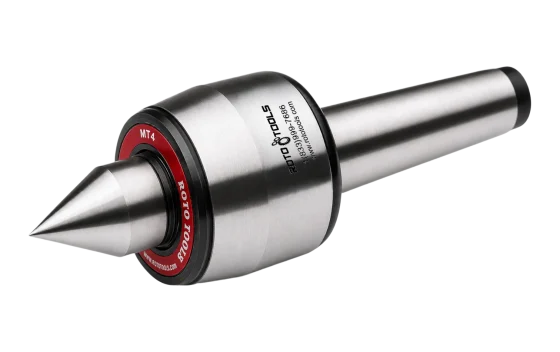
What is a Live Center?
A live center is a precision workholding device that mounts in the lathe tailstock and supports the end of a rotating workpiece. Internal bearings let the point revolve with the part, which eliminates the friction, heat, and galling you get from a solid, non-rotating dead center.
A live center is sometimes called a rotating tailstock center or simply a tailstock center. The defining feature is the internal bearing pack that lets the point rotate.
Run-out is everything
A tenth indicator on the rotating 60° point shows the true picture. The accuracy of the part is no better than the accuracy of the center.
Bearings carry both loads
Tailstock pressure pushes axially; part weight and cutting forces push radially. The bearing arrangement handles both.
Heat and contamination are the enemies
Chips, coolant, and grit shorten bearing life. Sealing and lubrication protect the pack.
Lubricated for life
RotoTools bearings use Kluber ISO-Flex NBU-15 grease. Shanks are ground to gage-quality tapers.
Live Center Anatomy
Every component plays a role in holding the part true and delivering long bearing life.
| Component | Function |
|---|---|
| Tapered shank | Seats and locks into the tailstock quill (usually a Morse taper). |
| Body / housing | Hardened steel housing that carries the bearing pack and resists wear. |
| Internal precision bearings | Let the point rotate; sized for radial load, axial load, and RPM. |
| Rotating spindle | The shaft the bearings support; carries the point. |
| Point | The 60° tip that enters the workpiece center hole; steel or carbide-tipped. |
| Seals / lubrication | Keep chips and coolant out and grease in, extending bearing life. |
Types & Point Styles
Different jobs need different points. RotoTools builds a full range so you can match the center to the part.
- CNC Standard Point — balances rigidity and clearance for most turning work.
- Long / Extended Point — reaches into recesses and gives more tool clearance, at the cost of some rigidity.
- Tracer Point — clears a tracer or steady rest; ideal for follow-rest turning.
- Carbide-Tipped — a 60° carbide tip for abrasive, hard, or high-volume work where wear resistance pays off.
- Bull Nose / Pipe Nose — a rotating cup that supports pipe, tube, and large-bore parts on the rim instead of a center hole. Available with or without threads.
- GEPY Interchangeable — one body accepts standard, tracer, female (cup), extended, and interchangeable bull nose heads. Quick head changes with a point-removal wedge.
- Spline-Rolling — purpose-built for the loads of spline and thread rolling; available in standard, tracer, and long point.
Need something off-catalog? Our Special Orders team builds custom live centers to your dimensions and application. Request a Special Quote.
Live Center vs. Dead Center
The single biggest decision is the point material. Through-hardened steel is cost-effective for general work; carbide earns its premium in tough, high-volume applications.
| Live Center | Dead Center | |
|---|---|---|
| Point Motion | Rotates with the workpiece on internal bearings | Solid, non-rotating — part spins against it |
| Friction / heat | Minimal — no point lubrication needed | High — needs point lubrication |
| Max RPM | High — suited to production and CNC speeds | Low — limited by friction and heat |
| Rigidity / accuracy | Excellent, but bearing run-out can transfer | Maximum — nothing to wear or deflect |
| Best for | General turning, high-speed CNC, heavy parts | Cylindrical grinding, exacting precision work |
| Wears via | Bearing wear (roughness, hesitation) | Point wear, grooves, wear rings |
| Service | Bearing / spindle replacement | Regrind to restore the point |
Short version: a live center is the default for turning because it tolerates speed and load without burning the center hole. A dead center earns its place in grinding and in the most exacting setups where bearing run-out would transfer to the surface.
Mounting, Tapers & Sizing
Most live centers mount on a Morse taper — a self-locking taper that seats and grips in the tailstock quill. A clean, undamaged taper is critical: nicks or burrs on either the shank or the socket will throw off run-out.
| Taper | Relative Size | Typical Application |
|---|---|---|
| MT-1 | Smallest | Small precision lathes and light parts |
| MT-2 | Small | Bench and toolroom lathes |
| MT-3 | Medium | General manual and light CNC lathes |
| MT-4 | Large | Mid-size CNC and engine lathes |
| MT-5 | Larger | Heavy engine and large CNC lathes |
| MT-6 | Largest Morse | Large, heavy-duty turning |
| SV-70 | Heavy-duty | High-load and lrge-machine applications |
SV70 is a heavy-duty mounting size used on larger machines. If you are unsure which taper your tailstock takes, send us the machine model and we will confirm it on your quote.
Accuracy, Run-Out & RPM
RotoTools precision-class live centers are built to hold tight TIR, with our highest-accuracy CNC centers ground to as tight as ±.00005″ run-out (half a tenth).
Max RPM
Every RotoTools part carries a Max RPM rating. Stay under it with margin to spare.
Run-out (TIR)
Check with a tenth indicator on the rotating 60° point. Rising TIR is an early warning of bearing wear.
Load capacity
Choose more capacity than the job strictly needs. Exceeding a center’s limits is dangerous.
Bearing life (L10)
Depends on radial load, axial load, and RPM. Leave headroom and avoid overload.
Applications & Industries
- General and production CNC turning
- Long shafts, axles, and lead screws
- Pipe, tube, and large-bore work (bull nose / pipe nose)
- Spline and thread rolling
- Aerospace, automotive, oil and gas, and heavy equipment machining
How to Choose a Live Center
Work through these in order and you’ll land on the right part:
- Taper. Match your tailstock (MT-1 to MT-6, or SV70).
- RPM. Confirm your top spindle speed is within the center’s Max RPM rating, with margin.
- Load. Add up part weight, tailstock pressure, and cutting forces; choose a capacity above that total.
- Point style. Standard for general work; long for clearance; bull nose for pipe and tube; carbide-tipped for abrasive or high-volume parts; GEPY interchangeable when one body needs to cover several jobs.
- Center-hole size and clearance. Match the point to your center-drill size and tool path.
- Accuracy. For the tightest finishes, specify a precision-class center and verify its published run-out.
Not sure? Send us your machine model, taper, top RPM, and part details and we will spec it for you. Request a Quote.
Care, Maintenance & Repair
A live center is a precision instrument and lasts longest when treated like one.
- Keep the taper clean. Wipe the shank and quill before mounting; protect both from nicks and burrs.
- Spin-test for bearing wear. Grip the spindle and rotate the point by hand — it should spin freely and smoothly. Roughness or hesitation means the bearings are worn.
- Watch run-out. A creeping TIR reading is an early warning sign.
- Repair instead of replacing. When bearings wear, RotoTools replaces the bearing pack and spindle to bring the center back to spec.
RotoTools repairs and regrinds the centers we build — and many that we don’t. See our Service & Repair page or request a service quote.
Why RotoTools
RotoTools is a manufacturer first. We design, build, repair, and regrind live and dead centers, and we back them with a full standard range plus custom work:
Full range
CNC (standard, tracer, long point), carbide-tipped, bull nose, GEPY interchangeable, and spline-rolling centers.
Built to spec
Gage-quality tapers, bearings lubricated for life, precision-class run-out where the job demands it.
MT-1 through MT-6 + SV70
We stock the complete Morse taper range plus the heavy-duty SV70 mount.
Quote-only, no surprises
Every product uses Request a Quote or Special Quote so you get pricing matched to your order.
- Live stock status color-coded: green = in stock, yellow = limited, red = made-to-order.
- In-house repair, bearing replacement, and regrinding keep your centers in service.
- Contact RotoTools: Sales@RotoTools.com | 833.999.ROTO (7686)