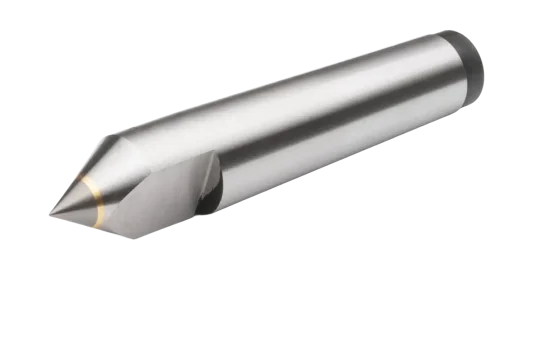
What is a Dead Center?
A dead center is a hardened, one-piece point that holds the end of a part during turning, grinding, or inspection. The center itself stays still; the workpiece rotates against it. The term refers to the function, not the location — a dead center can sit in a tailstock and still be “dead” because the point does not turn with the part.
Most dead centers are made from through-hardened bearing steel and ground to a standard 60° included point angle, seated against a matching center hole drilled in the workpiece. The result is a rigid, repeatable axis of rotation with no moving parts to introduce error.
Maximum rigidity
No internal bearings means nothing to deflect under tool pressure.
Best-in-class accuracy
Ideal for cylindrical grinding and high-precision turning.
Simplicity and value
Fewer parts, lower cost, and a center that can be reground many times.
Trade-off: friction
The fixed point rubs against the spinning part and must be lubricated.
How a Dead Center Works
In a typical “between centers” setup, one center supports the headstock end and another the tailstock end. The workpiece is driven in rotation while both ends ride on their 60° points.
- The part is center-drilled on both ends to create matching 60° seats.
- The dead center is mounted by its taper into the spindle or tailstock.
- Lubricant is applied to the point-to-part contact zone.
- The part rotates against the fixed point while the cutting tool or grinding wheel does its work.
Keeping the point lubricated is essential. Without it, friction heat can score the point, the center hole, or both — which is why high-pressure, high-volume jobs often move to a carbide tip or a live center.
Anatomy & Key Components
A dead center is deceptively simple, but every feature matters:
| Component | Function |
|---|---|
| Tapered shank | The mounting end, ground to a precise Morse taper (or SV70) for a self-locking fit. |
| Body | Through-hardened steel mass that carries load without flexing. |
| 60° point | The ground working tip that contacts the center hole — concentricity here is everything. |
| Carbide tip (optional) | A carbide insert brazed into a close-tolerance socket for extreme wear resistance. |
| Half-point relief (optional) | A large cutout that clears a grinding wheel on small-diameter work. |
| Extraction provision | Thread or flats that work with an extracting nut to knock the taper loose cleanly. |
Types & Point Styles
RotoTools builds a complete range of solid centers so you can match the tool to the job:
- Full Point Steel — the workhorse for turning and grinding; the full 60° point is retained.
- Half Point Steel — a large relief grinds clearance for the wheel on small-diameter parts.
- Full / Half Point Carbide-Tipped — a brazed carbide tip for abrasive, hardened, or high-volume work.
- Extended versions — added length for deep recesses or tool-clearance challenges.
- Full Point Large Carbide-Tipped — a heavier point for big, demanding parts.
- CNC Dead Centers — full, tracer, and long-point configurations for CNC turning, with extraction provisions.
- Mazak-compatible CNC — built to drop into Mazak tailstock systems.
Need a configuration that isn’t on the shelf? RotoTools designs and manufactures specials. Request a Special Quote.
Steel vs. Carbide-Tipped
The single biggest decision is the point material. Through-hardened steel is cost-effective for general work; carbide earns its premium in tough, high-volume applications.
| Feature | Through-Hardened Steel | Carbide-Tipped |
|---|---|---|
| Typical Use | General turning & grinding | Abrasive/hard parts, high volume |
| Wear resistance | Good | Excellent |
| Heat tolerance | Good with lubrication | Very high |
| Best for | Soft turning, most steels | Hardened steel, castings, long runs |
| Relative cost | Lower | Higher |
| Reground over life | Yes, many times | Yes |
Avoid cheap case-hardened points. Case hardening gives only a thin hard skin — once that skin is ground away during a regrind, the soft core is exposed. RotoTools builds with through-hardened steel and brazed carbide so worn points can be restored again and again.
Dead Center vs. Live Center
| Dead Center (Solid) | Live Center (Rotating) | |
|---|---|---|
| Point motion | Fixed – part rotates against it | Rotates with the part |
| Internal bearings | None | Yes (precision bearings) |
| Rigidity | Highest | High, but bearings can deflect |
| Friction / heat at point | Yes – needs lubrication | Higher RPM, longer unattended runs |
| Wear items | None (regrind the point) | Bearings (replaceable) |
| Accuracy | ±0.00005″ (½ tenth) TIR | ±0.00005″ (½ tenth) TIR |
Short answer: choose a dead center when you want the stiffest, most accurate setup and can manage point lubrication — especially for grinding. Choose a live center when speed, long runs, or heat make point friction a problem. RotoTools makes both, and can regrind or repair either one.
Mounting, Tapers & Sizing
Dead centers mount by a self-locking Morse taper. RotoTools supplies MT-1 through MT-6 plus the SV70 taper for larger machines.
- Match the taper to the socket. Use the taper your spindle or tailstock is bored for.
- Keep the taper clean. Nicks, dings, and burrs on the taper or socket destroy concentricity. Wipe both surfaces before every install.
- Plan for removal. Threaded centers and extracting nuts make removal clean and safe. RotoTools offers extracting nuts for MT-2 through MT-6 (part numbers 90002–90006).
Sizing tip: the bigger the taper, the more load and the higher the rigidity. Size to the machine’s tailstock bore and verify the part’s center holes are correctly drilled and deburred so the point seats fully.
Accuracy, Run-Out & RPM
For precision work, the center is part of the measurement chain: the accuracy of the finished part can be no better than the accuracy of the center supporting it.
Run-out / TIR
RotoTools dead centers are ground to ±0.00005″ (½ tenth) TIR. Mount, set a tenths indicator on the 60° point, and rotate to verify.
Point angle
US standard is a 60° included angle. Keep regrinds on-angle and concentric to maintain accuracy.
RPM
A solid center has no bearing speed limit, but friction heat sets a practical limit. Carbide tip or live center for high-RPM or long runs.
Ready to spec?
Request a Quote and our team will help you size the right center for your tolerance and speed.
Applications & Industries
- Cylindrical grinding — the classic application; nothing beats a solid point for stiffness.
- Precision and soft turning — finishing shafts, pins, rolls, and spindles between centers.
- Hard turning and abrasive materials — carbide-tipped points for hardened steel and castings.
- Large and heavy parts — oversized large carbide-tipped points for big, demanding work.
- Inspection and setup — holding parts true for measurement and layout.
How to Choose a Dead Center
Work through these five questions and you’ll land on the right part:
- Steel or carbide? Through-hardened steel for general turning and grinding; carbide-tipped for abrasive, hardened, or high-volume parts.
- Full or half point? Full point for general use; half point when a grinding wheel needs clearance on small diameters.
- What taper? Match your spindle / tailstock bore — MT-1 to MT-6 or SV70.
- Standard or extended? Extended length for deep recesses or extra tool clearance.
- CNC or Mazak system? Choose the CNC or Mazak-compatible series with the right extraction provision.
Stock availability is flagged in plain terms: In stock, Limited availability, or Made-to-order. Made-to-order parts are quoted with a lead time.
Care, Maintenance & Re-grinding
A solid center is one of the most maintainable tools in the shop – there’s nothing to fail, only a point to keep true.
- Lubricate the point. Friction between the fixed point and the spinning part generates heat. Proper center lubricant prevents scoring of both the point and the part’s center hole.
- Watch for wear. Regrind once you see visible wear, grooves, or a wear ring on the point.
- Re-grind on-spec. Restore the original 60° angle and concentricity to the taper. Through-hardened and carbide points tolerate repeated regrinds; case-hardened points do not.
- Check the part too. Inspect and re-drill center holes — a worn or shallow center hole undermines even a perfect point.
RotoTools offers full service: send in a worn center and we’ll regrind or repair it. Learn more on our Service / Repair page.
Why RotoTools
RotoTools designs, manufactures, repairs, and regrinds precision lathe centers — all from one source, all built to the same standard:
±0.00005″ TIR accuracy
Ground to half a tenth run-out — the accuracy of the finished part can be no better than the center supporting it.
MT-1 through MT-6 + SV70
Full Morse taper range plus the heavy-duty SV70. Extracting nuts available for MT-2 through MT-6 (90002–90006).
Steel and carbide-tipped
Full range: full and half point, extended, large carbide, CNC, and Mazak-compatible.
Service and repair built in
Worn points are reground and returned to spec. A quote-only catalog keeps things simple.
Contact RotoTools: Sales@RotoTools.com | 833.999.ROTO (7686)